





How to predict daylight conditions in buildings during the design phase

Contents |
[edit] VELUX Daylight Visualizer - complex daylight analysis made simple
The importance of predicting daylight conditions prior to design realisation
Daylight is essential in creating a healthier indoor environment for building occupants, contributing to comfort and productivity. It also provides appropriate illumination to carry out tasks and gives people a connection with the outdoors.
Optimising the amount of natural light available in a building means less electric lighting is required during the day. Daylight simulation actively supports a commercial building’s compliance and user needs by providing critical overviews of building performance.
Being able to predict a building’s daylight conditions at the design stage will avoid costly changes downstream and gives the confidence that the building design will:
- Meet any specifications and standards for daylight, e.g. EN 17037
- Minimise the need for artificial lighting
[edit] Using the VELUX Daylight Visualizer to predict daylight conditions in buildings
|
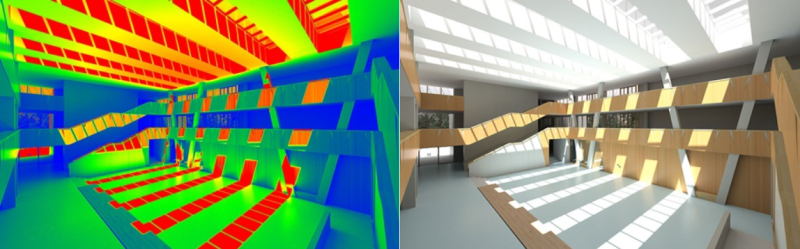
| Luminance rendering under sunny sky with false colour mapping, Hessenwaldschule school project - see the case study |
The VELUX Daylight Visualizer is a free professional 3D simulation tool created to aid architectural design by measuring daylight levels in commercial building projects. The digital device makes it possible to evaluate the quantity and distribution of daylight, considering influential parameters such as building geometry, external obstruction, interior divides, and material properties in the process.
The tool also presents an opportunity to evaluate daylight in compliance with EN 17037 regulations. Accurate daylight
reporting means design choices can be made in line with building regulations of any country.
Key Features
- Visualise luminance, illuminance and daylight factor levels
- Create 3D perspective renderings quickly and easily
- Import 3D models from a range of CAD/BIM software
- Evaluate compliance with EN 17037 daylight requirements
- Validated for simulation accuracy against CIE 171:2006 test cases
Key Benefits
- Calculate and compare daylight solutions before design realisation
- Achieve an optimal design for daylight availability
- Plan with accurate and visual daylight level reports
- Ensure regulatory requirements are being met
- Visualise the result of a daylight design in advance
Available by download, this digital tool takes an innovative approach to measuring daylight levels, presenting you with concise virtual samples that help you realise design goals. The Daylight Visualizer also works to improve the commercial viability of a building project through the reduction of planning error
The software is available for both PC and MAC platforms; please visit the VELUX Commercial website to download it.
[edit] Case study - Oasis Academy

Oasis Academy, a new school in Leesbrook, UK, was designed with a clear objective: deliver an exceptional learning facility for an entire community to enjoy.
This ambitious goal has in part been achieved with the installation of modular skylights to spread daylight throughout a thriving and modern learning environment.
To help bring design goals into light at the concept stage of the project, the VELUX Daylight Visualizer was chosen to accurately predict and analyse daylight levels in 3D form in accordance with the Department for Education (DfE) requirements. Simulated daylight factors also enabled the architect to make design decisions that maximised daylight exposure and minimized building costs.
Read our case study to find out more about a harmonious learning environment full of natural light.
[edit] Related articles on Designing Buildings
Featured articles
Check out some of the best features and news from Designing Buildings as well as key stories from around the web.

CIOB celebrates positive Ofsted report.

The Building Safety Regulator announces a call for evidence.

Government approach could undermine delivery and regeneration.
World's first mass timber data centre.

The overlooked environmental aspect of data centre development.
Introduction to radon awareness

New technical information sheet published by CIOB.

Updated supplier guide can help electrical contractors engage with NHP.

CIAT confirm the winners of the 2026 architectural technology awards.

Government launches a one stop shop for flood preparedness.

Sir Edwin Lutyens: Britain's greatest architect? Book review.

CIOB publishes free template to help assess and manage risks.
ECA's reflections on Party Conference season

Burnham wants to be confident of winning before asking for a fresh mandate.
New Chief Construction and Scientific Adviser

Sergio Cavalaro, Professor of Infrastructure Systems at Loughborough University.